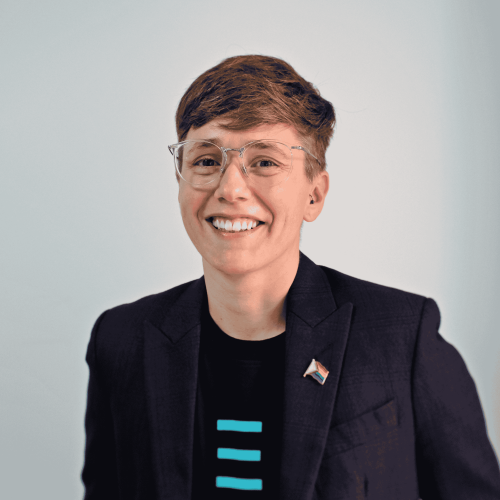



How SphereBio is Developing Scalable Solutions to Complex Health Issues
In this #MeetTheMB100 interview, Julieta Luz Porta, Co-Founder & CEO of SphereBio, shares how they are harnessing nanotechnology, artificial intelligence, and synthetic biology to revolutionise how we treat cancer and autoimmune diseases.
This interview series is sponsored by EY, Hogan Lovells, Forster Communications, Green Frontier Capital, Kenya Climate Ventures (KCV) and The Portman Estate.

Long Form Questions
Meaningful Business (MB): What are the challenges you are trying to solve, and why do they matter to you?
Julieta Porta (JP): One of the major barriers in modern medicine is the inability to efficiently deliver complex therapies into cells. Over 99% of biological molecules degrade before reaching their intended targets, which limits the potential of otherwise promising treatments, especially for aggressive cancers such as glioblastoma (which is one of the most difficult-to-treat brain cancers, characterised by a low survival and a high recurrence rate). At SphereBio, we are addressing the challenge of intracellular delivery and developing scalable, global solutions to complex health issues.
MB: How is your work tackling these challenges, and what impact are you having?
JP: Our biotech delivery platform, XSpheres, efficiently delivers molecules to cells and trains them to produce specific responses to recognise and eliminate elusive cancer cells.
Our flagship product, OncoSpheres™, is a personalised cancer vaccine derived from the patient’s own tumour, which retains the complete diversity of tumour antigens. This method enables the immune system to recognise the tumour more comprehensively. Having demonstrated increased cellular uptake and immune activation in vitro, we are progressing towards in vivo proof of concept.
Beyond the lab, we are developing a scalable platform that is adaptable to multiple therapeutic areas, from oncology to genetic and infectious diseases, so that we can deliver life-saving therapies to patients worldwide.
MB: How do you work with partners in the broader ecosystem to achieve your mission?
JP: Collaboration is essential for turning breakthrough science into tangible, real-world impact. SphereBio works closely with leading academic, clinical, and industry partners to accelerate the development of global health solutions.
We collaborate with researchers from Harvard-affiliated hospitals such as the Dana-Farber Cancer Institute and Brigham & Women’s Hospital, and gather guidance on clinical applicability, trial design, and translational strategy. We also work with prominent pharmaceutical companies on commercialisation and market strategy.
By combining scientific excellence with strategic insight, we can scale our solutions to reach patients faster and more efficiently.
MB: What is your ambition for the future of your business, and what support do you need to increase your impact?
JP: We want SphereBio to be the global standard for safe and efficient intracellular delivery, transforming the way biologics and complex therapies reach their targets within cells.
In the near term, our focus is on bringing OncoSpheres to a clinical proof-of-concept stage, starting with glioblastoma as a challenging yet high-impact indication. In the long term, we envision expanding our platform to address multiple therapeutic areas, including other hard-to-treat cancers, as well as genetic, infectious, and autoimmune diseases.
To achieve this, we’re cultivating strategic partnerships with pharmaceutical and biotech companies that can support us with co-development and licensing, as well as investors who share our vision for scalable impact. We’re also interested in partnerships that bring a wealth of regulatory and manufacturing expertise, as this will be key to ensuring our technology can be produced to the quality and scale required for global distribution.
Quickfire Questions
MB: Can you share a mistake that you’ve learned from?
JP: Early on in my journey, I listened to far too many “opinologists”—people with opinions but who had no real expertise. This caused a lot of unnecessary noise. I learned to filter feedback, trust the data, and focus on patients and mission-driven insights.
MB: What is something you wish you were better at?
JP: Delegating more quickly. As a founder, it’s tempting to cling to too many details. I’ve realised that empowering others sooner not only enhances the team’s skills but also accelerates company growth and fosters a culture of ownership.
MB: What underrated skill do you wish more impact-focused leaders invested time in?
JP: Active listening. Not just with investors, but with scientists, patients, and teams. It builds trust, uncovers blind spots, and sparks innovation. Leaders often underestimate the extent to which clarity and alignment can be achieved simply by listening deeply.
MB: What is one book that everyone should read?
JP: Sapiens: A Brief History of Humankind by Yuval Noah Harari. It challenges how we perceive human progress, decision-making, and collective imagination – and serves as a reminder to us all that vision and storytelling shape societies, just as they shape companies and drive transformative innovations.
MB: What are the podcasts you can’t imagine your day without?
JP: TechCrunch for tech and AI trends, Andreessen Horowitz Future for strategy, MIT Technology Review for frontier insights, and Lex Fridman’s podcast for deep conversations. They help me stay inspired at the crossroads of science, technology, and humanity.