


How Rifò’s fully integrated circular fashion model is proving that waste can become value again

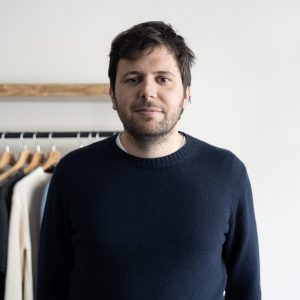
In this #MeetTheMB100 interview, Niccolò Cipriani, Founder of Rifò, discusses how he is changing the resource-intensive fashion industry and shares his vision to make circularity the norm, not the niche.
This interview series is sponsored by EY, Hogan Lovells, The Portman Estate and Forster Communications.
Long Form Questions
Meaningful Business (MB): What are the challenges you are trying to solve and who are the main beneficiaries?
Niccolò Cipriani (NC): The fashion industry is one of the most resource-intensive and wasteful sectors in the world. It extracts virgin materials at an unsustainable rate, generates massive textile waste, and often relies on opaque and unfair supply chains. At Rifò, we are addressing three interconnected challenges, such as overproduction and textile waste, dependence on virgin raw material and loss of local craftsmanship and fair value in supply chains.
Our main beneficiary is the environment, through reduced resource extraction and waste. Additionally, our beneficiaries are local textile workers and artisans in the Prato district, whose skills are preserved and fairly valued. Consumers also benefit from our activities, by gaining access to high-quality circular garments designed to last. Finally, direct beneficiaries are vulnerable migrants and new artisans involved in our social project Nei Nostri Panni, who receive training and concrete employment opportunities.
MB: What is your solution and what impact have you made to date?
NC: Our solution is a fully integrated circular fashion model based in Tuscany, Italy. We recover pre-and-post-consumer textile waste, regenerate fibers into new high-quality yarns, and then produce garments locally within a short and transparent supply chain. Moreover, we design mono-material pieces that are easier to recycle again. Finally, we offer repair services and take-back initiatives to extend product life.
To date, we have recycled thousands of kilograms of textile waste into new garments. We have built a local supply chain involving small, family-run textile businesses. We became a certified B Corp and WFTO member, strengthening our social and environmental accountability. We have also created measurable social impact through long-term training programs in textile regeneration.
MB: What has been the most complex or underestimated part of delivering this work?
NC: The most underestimated challenge has been changing perception. Convincing the market that recycled fibers can be premium, durable and beautiful has required continuous education. There are still misconceptions that regenerated yarns are lower quality or less warm.
Another complex aspect is managing a local, transparent supply chain. Working with small artisans ensures quality and fairness, but it also requires coordination, flexibility and long-term relationship building.
MB: What is the biggest threat to you right now and why?
NC: The biggest threat is the persistence of ultra-fast fashion and price competition driven by unsustainable production models. When consumers are constantly exposed to extremely low prices, it becomes harder for responsible brands to communicate the real value behind ethical production, local craftsmanship and circular processes. Additionally, economic uncertainty makes customers more price-sensitive, even if they share sustainability values.
MB: What is your ambition for the future of your business, and what support do you need to increase your impact?
NC: Our ambition is to scale circular fashion without losing our local identity. We aim to increase the percentage of regenerated fibers in the industry as well as expand our social training programs. We also want to strengthen our international presence while keeping production local and developing more closed-loop systems, including enhanced take-back and second-life platforms.
To increase our impact, we need financial support for scaling circular infrastructure and policy frameworks that reward circular production over extractive models.We believe circularity must become the norm, not the niche.
Quickfire Questions
MB: Can you share a mistake that you’ve learned from?
NC: In the early years, we sometimes tried to grow too quickly without fully consolidating internal processes. We learned that sustainable growth requires solid operational foundations, especially in a circular model where complexity is higher.
MB: What is something you wish you were better at?
NC: We wish we were better at simplifying complexity in communication. Circular supply chains are intricate, and translating that complexity into clear, inspiring messages remains an ongoing challenge.
MB: What are you most proud of about your work?
NC: We are most proud of having built a truly local circular supply chain in Prato, one of the historic textile districts in Italy. We didn’t relocate production to cut costs – we chose to regenerate value in the same territory where textile regeneration has been practiced for over a century.
MB: What is the one book that everyone should read?
NC: Doughnut Economics by Kate Raworth. It challenges the traditional growth model and proposes a framework where economic development operates within planetary boundaries while ensuring social foundations.
MB: What are the sites, blogs or podcasts that you can’t imagine your day without?
NC: I refer to Pambianco news for industry insight, Fashion Revolution resources, B corp community news as well as local textile district networks and sustainability research platforms such as the Moda Sostenibile Podcast.